
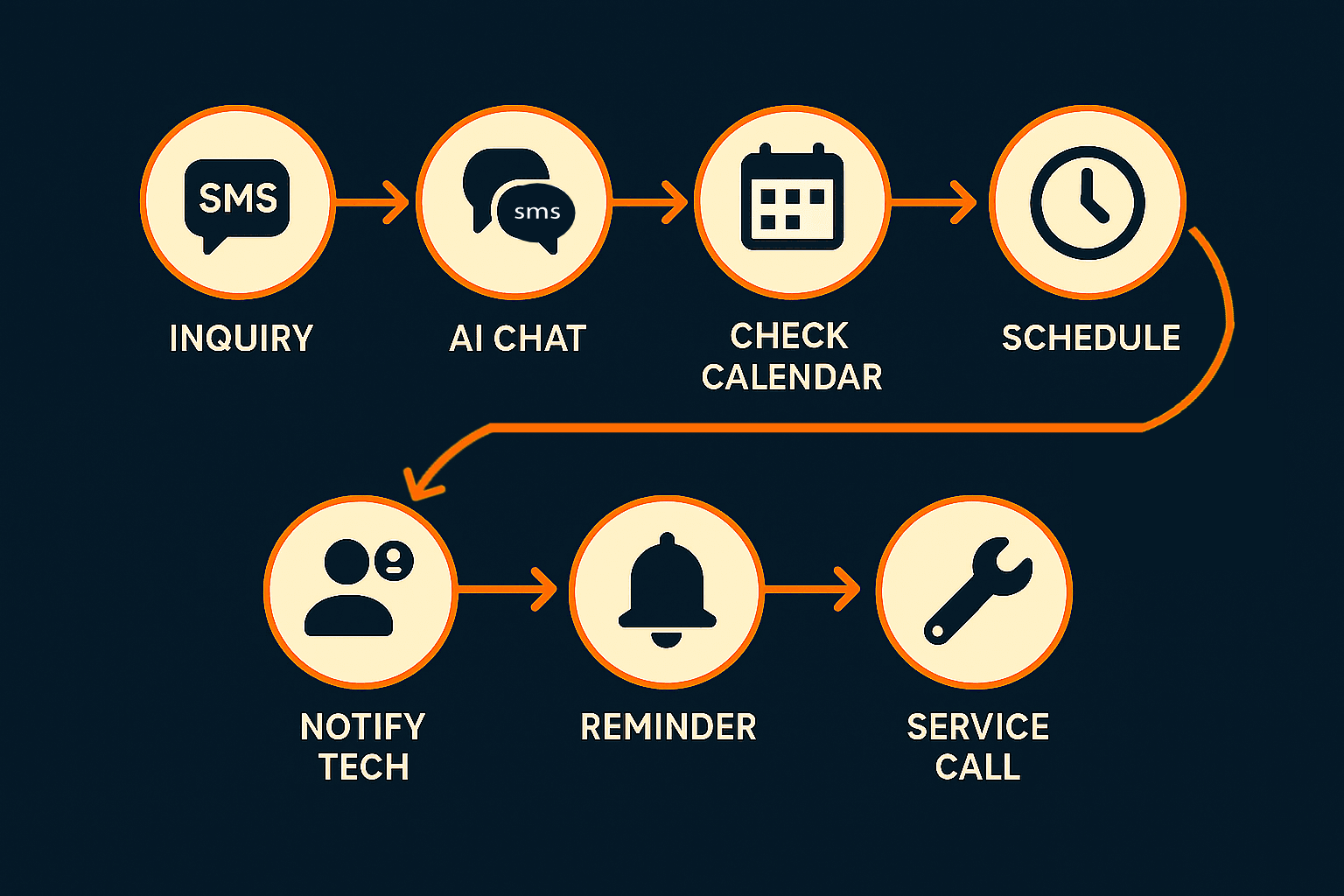
AI Automation in Blue-Collar Trades: Hype or Essential Next Step?
How AI is reshaping the skilled trades – and why it matters for the industry.
The skilled trades – plumbing, electrical work, HVAC, and similar blue-collar services – have long been seen as hands-on domains relatively untouched by high-tech automation. An AI can churn through spreadsheets or write emails, but it can't crawl under a house to fix a leaky pipe, right? This reality has led many to question whether AI automation tools have a meaningful role in such trades. Yet a closer look reveals that while AI isn't replacing plumbers or electricians on the job site, it's increasingly automating the "sitting work" – the scheduling, paperwork, and communication tasks – that surround those jobs. This article examines the current appetite for AI in the trades, real use cases emerging today, the barriers tradespeople face in adopting technology, and the big-picture trends suggesting that AI automation is poised to become essential in these industries.
The Current Appetite for AI in the Trades
How interested are blue-collar service providers in AI automation right now? Until recently, adoption was tepid – many technicians and small shop owners were skeptical that AI could help with their very physical, people-centric work. However, 2024–2025 saw a sharp uptick in interest and experimentation. In late 2024, only about 42% of trade business owners had even explored AI tools. Just six months later, by spring 2025, over 70% had tried some form of AI, and nearly 40% were using it actively in their operations. Importantly, those early adopters are seeing value: 57% of tradespeople who've used AI say it has helped their business grow or at least "somewhat" grow. What are they using AI for? Largely, it's not about robots turning wrenches – it's about office and management tasks. Skilled trades professionals report that AI helps cut down administrative busywork, run leaner operations, and free them to focus on the trust-driven, hands-on work that only humans can do. For example, younger owners have embraced generative AI for writing polished quotes, marketing copy, or staff training materials. In fact, business owners under 35 are almost twice as likely to be active AI users compared to those over 65 – but adoption spans all age groups now. This isn't just a fad confined to tech-savvy youth; it's a broad transformation in how trade businesses operate. That said, many in the industry remain cautious or unconvinced. A significant segment still asks: Is AI really practical for my small shop? Surveys indicate the biggest hurdle is not lack of interest or even cost, but clarity. Many non-adopters simply don't understand what AI could do for them or assume their business is "too small" to benefit. Misconceptions abound – for instance, experienced tradespeople know that no algorithm can physically replace years of craft knowledge in a crawlspace or attic. They're not wrong about that. But what's changing is an awareness that AI can revolutionize the surrounding tasks – the customer calls, scheduling, routing, quoting, and paperwork that consume time. As we'll see next, practical use cases are emerging that show even the smallest plumbing or HVAC company can gain from a well-placed dose of automation.
Real Use Cases: From Smart Scheduling to Instant Quotes
If AI isn't (yet) fixing burst pipes or wiring a house, where is it making a difference? It turns out that a host of AI-driven automation tools are already tackling pain points in blue-collar workflows. Here are some real and emerging examples making waves in plumbing, electrical, HVAC and similar services:
AI-Assisted Scheduling & Dispatch
One of the most tedious tasks in a service business is scheduling appointments and dispatching techs efficiently. AI tools can optimize this by matching jobs with the right technician based on location, expertise, and availability. For instance, ServiceTitan's platform uses an AI assistant to assign jobs intelligently (considering who's closest and best suited) and even predict optimal appointment times to maximize jobs per day. This kind of route optimization cuts drive time and fuel costs, ensuring techs spend more time earning and less time driving. In practice, trade businesses using AI scheduling report fewer gaps in their calendars – ServiceTitan users saw 20% fewer scheduling gaps, translating to about 1–2 extra jobs per tech each week. Moreover, 24/7 online booking systems allow customers to self-schedule appointments after hours, meaning a plumber can wake up to a full calendar that was filled overnight without any phone tag.
Faster, More Accurate Quoting
Preparing detailed quotes or estimates can normally take a lot of manual calculation and typing. AI is speeding this up dramatically. AI-driven quoting tools help contractors provide faster, more accurate estimates – often by auto-calculating material and labor costs from a template or even analyzing a photo of the job. For example, Housecall Pro (a field service software) can auto-fill flat-rate prices, labor, and materials to generate a professional estimate, saving hours per week that would be spent doing it by hand. Some contractors are even using generative AI like ChatGPT to draft itemized estimates in seconds. In one case, a plumber described a water heater replacement job to an AI and got back a polished, line-item quote in 30 seconds – a task that normally might take 15–20 minutes. Speed matters, because the faster you get a quote to the customer, the higher the chance you win the job.
Routing and Fleet Optimization
For businesses with multiple service calls a day, efficient routing is gold. Modern field service platforms now embed AI or algorithms to create optimal daily routes at the click of a button. For instance, Jobber's software can auto-generate the most efficient routes for all jobs in a day or week, and even re-optimize on the fly if plans change, helping teams squeeze in more calls per day. In practice, trade companies say workflow optimization is where AI delivers real ROI – 69% of service business owners report AI's biggest impact is reducing technician downtime and improving routing and job completion rates. Less windshield time means more profit and happier customers who get faster service.
Invoicing and Administrative Tasks
The "paperwork" side of trades is a prime target for automation. Tools now exist that convert completed jobs into invoices automatically and send them to customers, even nudging clients with payment reminders without human involvement. Many all-in-one platforms (Housecall Pro, Jobber, etc.) tie together the whole chain: when a job is marked complete on a tech's mobile app, the system can instantly email an invoice and later ping the customer if payment is overdue. By automating invoicing, billing, and report generation, small shops save hours and accelerate their cash flow. Nearly 80% of trade business owners in one survey said that robust, tech-driven invoicing and cash flow tools are essential to their operation – a sign that these basic automations are becoming standard.
24/7 Customer Communication
Blue-collar businesses can't always afford a full-time receptionist, yet missing calls means missing revenue. AI has an answer: virtual assistants and chatbots. For example, AI-driven answering services like Rosie AI will pick up the phone with a natural-sounding voice, book appointments, and filter out spam calls at any hour. Plumbers using such tools have captured 15–20% more revenue from emergency calls that they'd otherwise miss at night or on weekends. Likewise, on websites, AI chatbots (e.g. Tidio) engage visitors, answer common questions about services, and allow customers to book jobs directly through a chat interface. One plumbing company reported their website chatbot captured 23 additional leads in the first month – leads that would have bounced off the site with unanswered questions. These tools effectively give even a one-truck operation a 24/7 customer service presence to match larger competitors.
Smarter Maintenance & Inventory
Forward-looking firms are also tapping AI for predictive insights. HVAC and mechanical service companies use predictive analytics to identify equipment likely to fail before it breaks, so they can schedule preemptive maintenance. In fact, about 30% of trade business owners report using AI-based predictive maintenance to prevent costly emergency calls and downtime for clients. Others are leveraging machine learning to forecast inventory needs – ensuring the right parts are in stock for upcoming jobs. For example, an AI system might analyze your past service records and alert you that water heater part XYZ tends to fail around the 10-year mark, and you've got several customers hitting that window. Stocking that part (or informing the client proactively) could secure a job and avoid a crisis. These predictive tools tie directly into long-term savings and revenue: fewer surprise breakdowns for customers and fewer truck runs for parts for the business.
Training and Knowledge Retention
While not as widespread yet, some trades are experimenting with AI and augmented reality (AR) for training. AR and AI-driven simulations can help apprentices practice complex repairs in a virtual environment, learning from mistakes without real-world consequences. On the job, a technician faced with an unusual problem might use an AI assistant on their phone to troubleshoot – for example, by uploading a photo of an unfamiliar part or error code and getting instant diagnostic advice. These tools don't replace a veteran's know-how, but they do help newer technicians "close the experience gap" faster. As many seasoned tradespeople retire, capturing their knowledge in AI systems or training programs will be vital to upskill the next generation quickly.
Each of these examples underscores a pattern: AI in blue-collar sectors is not about automating the core craft, but automating around it. From scheduling and routing to estimating and customer service, these tools handle the repetitive or data-driven tasks that eat up time. The ROI can be substantial. Case studies show small service companies reclaiming anywhere from 5 to 10+ hours a week by offloading routine tasks to AI – time that can be reinvested in taking more jobs or simply improving work-life balance. In dollar terms, capturing just a couple of extra service calls per month (which AI-driven scheduling or answering can facilitate) easily pays for the software. No wonder that active AI users in the trades report gaining back an average of 3.2 hours per week (over 160 hours a year) of productivity.
Barriers on the Shop Floor
If the benefits are so great, why isn't every plumbing or electrical contractor already running an AI-optimized operation? The reality is there are still significant barriers and concerns among blue-collar professionals when it comes to technology adoption. Understanding these barriers is key for both tool developers and the businesses themselves as they navigate this transition.
Tech Literacy and Training
A large portion of tradespeople, especially older generations, are not extremely tech-savvy. Learning new software or trusting AI recommendations can be intimidating for veteran plumbers or electricians who have "always done it by hand." There's a cultural gap to bridge – in the field, practical experience has always been king, so fancy software initially meets skepticism. If an AI scheduling tool isn't implemented thoughtfully, it could confuse staff or even slow them down at first. Vendors and business owners must invest in proper training and change management so that the crew understands why the new tool helps rather than seeing it as just added bureaucracy. The good news is that this barrier is more about clarity than capability. In fact, among trades businesses not yet using AI, the overwhelming reason cited is "I don't understand what it would do for me" (around 39%) – not outright opposition. Once they see clear use cases and get hands-on experience, much of the fear can give way to aha! moments.
Cost Sensitivity
Small service businesses run on tight margins, so any new expense is scrutinized. However, interestingly cost is not the primary obstacle for adopting AI tools in this space. Many basic automation solutions are affordably priced (some even have free tiers for chatbots, etc.), and the potential gains – one saved job or prevented error – can justify the cost. Only about 3% of non-users in a recent industry survey said price was the reason they avoid AI. That said, convincing a scrappy four-person HVAC company to subscribe to a $300/month software is a challenge if they don't immediately see the ROI. Tool providers are responding by highlighting quick wins (e.g. case studies showing how one missed call can equal $1,200 lost revenue) and by offering scalable pricing that grows with the business. Over time, as these tools become standard, the cost will likely be seen more as an operating necessity (like paying for an internet connection) rather than a discretionary spend.
Workflow Complexity and Integration
Many trade businesses already juggle a patchwork of software – one for scheduling, another for accounting, another for GPS dispatch, etc. In fact, the average small trade company uses at least five different software systems, and larger ones use eight or more. This software sprawl can kill efficiency if systems don't talk to each other. Owners worry (rightly) that adding yet another app could create data silos or require duplicate data entry, making things more complicated instead of simpler. Integration is key: AI solutions must either integrate with common platforms or offer an all-in-one solution for them to truly streamline workflows. There's also the consideration of unique workflows – a one-size tool might not fit a specialized contractor's needs without customization. These concerns can slow adoption, as business owners take time to research and choose the right solution that won't disrupt their current operations. It underscores why many Pros say they want better guidance, clear ROI examples, and simpler tools from the market before jumping in.
Trust and Cultural Resistance
Beyond the practicalities, there is a human factor of trust. Tradespeople take pride in their experience and personal customer service. Handing over client interactions or business-critical decisions to an algorithm can feel like a risk. What if the AI sends a junior tech to a complex job that they can't handle? What if an automated quote underprices a job? These worries make some owners hesitant to go "all-in" on automation. There's also the fear of technology failures – e.g., a software bug that misdiagnoses a gas leak or double-books appointments. To overcome this, AI tools need to be marketed (and proven) as assistants rather than replacements. Many early adopters report that keeping a human-in-the-loop for oversight – for example, reviewing AI-generated quotes before they go out – helps build trust in the system until confidence grows. Additionally, some technicians and even customers have privacy or autonomy concerns. If a company introduces AI that tracks field staff movements or records calls, workers might feel uncomfortable (e.g. "are we being surveilled?"). Open communication and setting clear policies (like who owns the data from that AI-enabled headset) are important so that tech adoption doesn't sour team morale.
Legacy Customer Expectations
An often overlooked barrier is customer preferences. Not all clients are ready to embrace an automated experience. For instance, an older homeowner might prefer to talk to a human on the phone rather than an AI receptionist, or might be put off by a text-message quote versus a personal visit. One trades business owner noted that many of his older customers "want that person-to-person interaction," which makes him cautious about rolling out too much automation in front of the customer. The key here is offering options: AI can handle things in the background or offer digital convenience to those who want it, without alienating clients who expect a human touch. Over time, as more customers (especially younger ones) demand instant digital responses, this will become less of an issue. In fact, modern consumers are increasingly expecting seamless digital booking and communication even from local service providers. The challenge for businesses is to balance efficiency with a personal touch during the transition.
In summary, the barriers are real but largely surmountable. They boil down to awareness, ease of use, and trust. The data shows that once trades professionals understand what an AI tool can do and see it in action, many are willing to give it a shot – and often end up glad they did. The onus is on AI tool developers and industry educators to demystify automation for the trades, provide hands-on training, and design tools that fit neatly into existing workflows. Those who do will find an audience increasingly receptive to solutions that help them work smarter, not harder.
The Macro Trends Driving Automation Needs
Stepping back, why does any of this matter for the long run? The truth is that outside forces are converging to make AI automation not just an efficiency boost, but a necessary adaptation for blue-collar service businesses. Several macroeconomic and workforce trends are amplifying the need for automation in the trades:
Labor Shortages and an Aging Workforce
Across Western economies, skilled trades are facing a labor crunch. A huge cohort of baby-boomer electricians, plumbers, and technicians is retiring in the coming years, and too few young workers are lining up to replace them. Nearly 40% of U.S. tradespeople are over age 45, and as they exit, the industry risks losing both manpower and deep expertise. The U.S. Bureau of Labor Statistics projects demand for trades like plumbing and HVAC will remain strong through 2032, with thousands of job openings each year – yet many of those positions may go unfilled. It's not just the U.S.: many Western countries report similar trends of not enough newcomers entering these fields. This is where AI can act as a force multiplier. Automation isn't arriving to replace workers, but to rescue industries suffering from a lack of them. By automating what can be automated (administration, simple diagnostics, etc.), one technician can handle more jobs, and less experienced hires can perform like seasoned pros with AI guidance. In short, when you can't find enough skilled hands, you enlist some skilled algorithms to support the humans you do have.
Rising Service Demand and Expectations
At the same time, demand for repair and installation services is rising – driven by aging infrastructure, a boom in home improvements, and climate-related events requiring emergency repairs. Customers also expect more responsive and high-quality service than ever. We live in an age of Uber and Amazon, where people are used to real-time updates, online self-service, and instant communication. That mindset is increasingly carrying over to local services: homeowners now expect seamless web and mobile experiences when booking a technician, as well as flexible payment and financing options for big jobs. They want to be able to schedule a service online at 10pm, receive a text that "Your technician is en route," pay digitally, and even leave a review effortlessly. For a small plumbing or electrical business to meet these expectations at scale, AI-driven tools are indispensable. They enable the kind of quick responses and personalized touches (like automated "on my way" messages or follow-ups) that would be overwhelming to do manually for each customer. In essence, rising customer expectations are raising the bar for operational efficiency – a bar that can only be met by leveraging automation.
Generational Change in the Industry
The demographics of both the workforce and business ownership in the trades are shifting. Millennials and Gen Z are becoming the new technicians, managers, and customers. These generations are digital natives; they expect modern software in the workplace and gravitate towards employers who use tech to make jobs easier. For example, young technicians may prefer using an app for their schedule and communicating via messaging, rather than paper work orders and phone calls. However, there's currently a perception gap: only 23% of young people believe that skilled trades involve cutting-edge technology, whereas 89% of trades professionals (many older) say they use advanced tech daily. This disconnect has real consequences: because trades are seen as "low tech," only about 16% of young people would even consider a career in the trades. To attract fresh talent, trade businesses will need to shed the outdated image. Adopting AI and modern tools is one way to signal that these jobs are high-tech and forward-looking, not old-fashioned and dead-end. Progressive companies are already highlighting their use of tablets, software, even drones on job sites to entice recruits. Those that lag in tech adoption risk being seen as less appealing workplaces and could lose the talent war to more modernized competitors. In the long run, embracing AI is part of creating a sustainable workforce pipeline.
Competitive and Economic Pressures
Lastly, as AI automation gains ground, it will shift industry benchmarks. Early adopters are starting to advertise faster response times, 24/7 availability, and data-driven maintenance plans. Small companies using AI can appear "bigger" and more professional, punching above their weight. This competitive edge will likely spur others to follow suit. It's reminiscent of the early days of websites – at first, only a few local contractors had them, but once customers began to favor those who offered online info and booking, having a website became a basic requirement. We may see the same with AI-driven services: scheduling bots, instant quotes, and digital reports could become expected. Additionally, in an economic sense, tough times (like recessions or high inflation) often push businesses to optimize costs. Automation can help a service company maintain profitability by doing more with a lean team. Trades that adopt efficiency tools are better insulated against rising labor costs or volatile demand, because they can flexibly scale their operations with software. Those macro pressures – from customer expectations to labor scarcity – all point to one conclusion: automation isn't a luxury for these businesses; it's fast becoming a necessity.
Conclusion: From Optional to Essential
Not long ago, AI in blue-collar industries sounded like sci-fi – or at best, something only big companies would dabble in. But the narrative has rapidly shifted. The question is no longer if AI automation will reshape plumbing, electrical, HVAC and other trades, but how soon and to what extent. We've seen that many frontline service providers are already using AI tools to amplify their productivity and professionalism, from automated scheduling and route planning to instant invoicing and chatbot customer service. They're reclaiming hours of their week and boosting revenue by letting machines handle the rote tasks. Crucially, this isn't replacing the skilled labor – the hands-on work remains hands-on, and always will. Instead, it's augmenting those skilled hands with better information and more free time to focus on the craft and the customer.
For small businesses that develop AI automation tools, all signs point to a growing and eventually essential market among blue-collar service providers. The appetite for AI solutions in the trades is growing fast as success stories spread and tools become more user-friendly. Early adopters are reporting tangible wins – higher booking rates, fewer missed leads, improved customer retention – which will drive competitive momentum. Yes, there are barriers to address: clarity, training, trust, and integration. But none of these are insurmountable, and the most forward-thinking vendors and trade companies are already overcoming them with education and smart implementation.
Looking at the big picture, the macroeconomic winds favor more automation in these sectors. Labor shortages mean every technician's time is more precious than ever – you simply can't afford to waste skilled hours on paperwork or chasing voicemails. Consumer expectations for speed and convenience are rising – you can't grow a business on old-fashioned processes when the next company offers an Uber-like service experience. And a new generation of both workers and customers will increasingly choose trades that leverage technology over those that do not.
In the end, AI automation for blue-collar businesses will transition from a nice-to-have efficiency booster to a must-have competitive necessity. We're likely approaching a tipping point where not using AI will put a service provider at a serious disadvantage. The good news is that embracing these tools can yield a virtuous cycle: more efficiency, more capacity, better service, and even a more attractive industry for new talent. The plumber of the future might still carry a wrench, but they'll also carry a smartphone loaded with AI assistants – and they'll wonder how anyone ever ran a successful business without them. The bottom line for the trades is clear: those who work smarter, not just harder, with the help of AI will be the ones to thrive in the years ahead. And for the companies building these AI solutions, the mission is an exciting and worthy one – to equip the unsung heroes of our infrastructure with the smartest toolbox we can create.
Sources
- housecallpro.com, "071525 AI Industry Report – final", AI-assisted Skilled Trades (2025). Source
- housecallpro.com, "071525 AI Industry Report – final", Executive summary – 42% explored AI, 70% tried, ~40% use actively, 57% say it helped growth (Spring 2025). Source
- housecallpro.com, "071525 AI Industry Report – final", Pros under 35 twice as likely to use AI; 56% more growth with 2+ tools; Gen Z leads, boomers follow (2025). Source
- housecallpro.com, "071525 AI Industry Report – final", 73% say AI hasn’t changed hiring; only 3% cite price; biggest barrier is clarity (2025). Source
- housecallpro.com, "071525 AI Industry Report – final", 3.2 hours/week gained (160+ hours/year), leads after hours, 5 hours/week saved; 27% assume too small, 3% cost, need ROI calculators, case studies, simpler tools (2025). Source
- aionx.co, "Best AI for Plumbers 2025: Automate Scheduling & Estimates", key features – 24/7 booking, reminders (no-shows −40%), smart estimating, invoicing (2025). Source
- aionx.co, "Best AI for Plumbers 2025", instant estimates (photo + ChatGPT), proposals, troubleshooting assistant, marketing content (2025). Source
- aionx.co, "Best AI for Plumbers 2025", Rosie AI – AI answering service; instant notifications (2025). Source
- aionx.co, "Best AI for Plumbers 2025", Tidio – 24/7 website chat, lead capture, manual takeover (2025). Source
- aionx.co, "Best AI for Plumbers 2025", 27% of calls missed, ~$1,200 lost revenue per missed call (2025). Source
- getjobber.com, "Jobber Now 2025: New Features and Updates", spend less time driving, more time earning; "Hey Jobber, do it for me" (2025). Source
- simprogroup.com, "Workflow Optimization: Digital Tools Drive Growth for Trade Businesses", 69% see AI impact on workflows; 30% predictive maintenance (2025). Source
- simprogroup.com, "Workflow Optimization", ~80% consider robust invoicing essential; cash flow king; job management, quoting, scheduling (2025). Source
- simprogroup.com, "Workflow Optimization", software sprawl killing efficiency; 23% young people see trades as cutting-edge vs 89% pros use tech; 16% would consider trades (2025). Source
- simprogroup.com, "Workflow Optimization", data expertise, modernize recruiting, tech-driven culture, lag in tech = outdated to talent (2025). Source
- medium.com, Roman Fedytskyi, "Will AI Replace Plumbers and Roofers? Or Just Redesign Their Toolbox?", AI quoting, scheduling, inventory; AI as support; diagnostic tools, drones, AR, experience gap; tech hurdle, ethical concerns; BLS 2032, AI to rescue industries (2025). Source
- medium.com, Roman Fedytskyi, BLS demand strong through 2032; aging infrastructure, climate; AI to rescue industries from labor shortage (2025). Source
- servicetitan.com, "How to Meet and Exceed the Modern Customer’s Expectations", 2025 Consumer Trends – seamless web/mobile, flexible payment, multiple generations (2025). Source
- ptt.edu, "What's the No. 1 Factor Contributing to the Skilled Labor Shortage?", nearly 40% of skilled tradespeople over 45; aging out faster than replacement. Source